
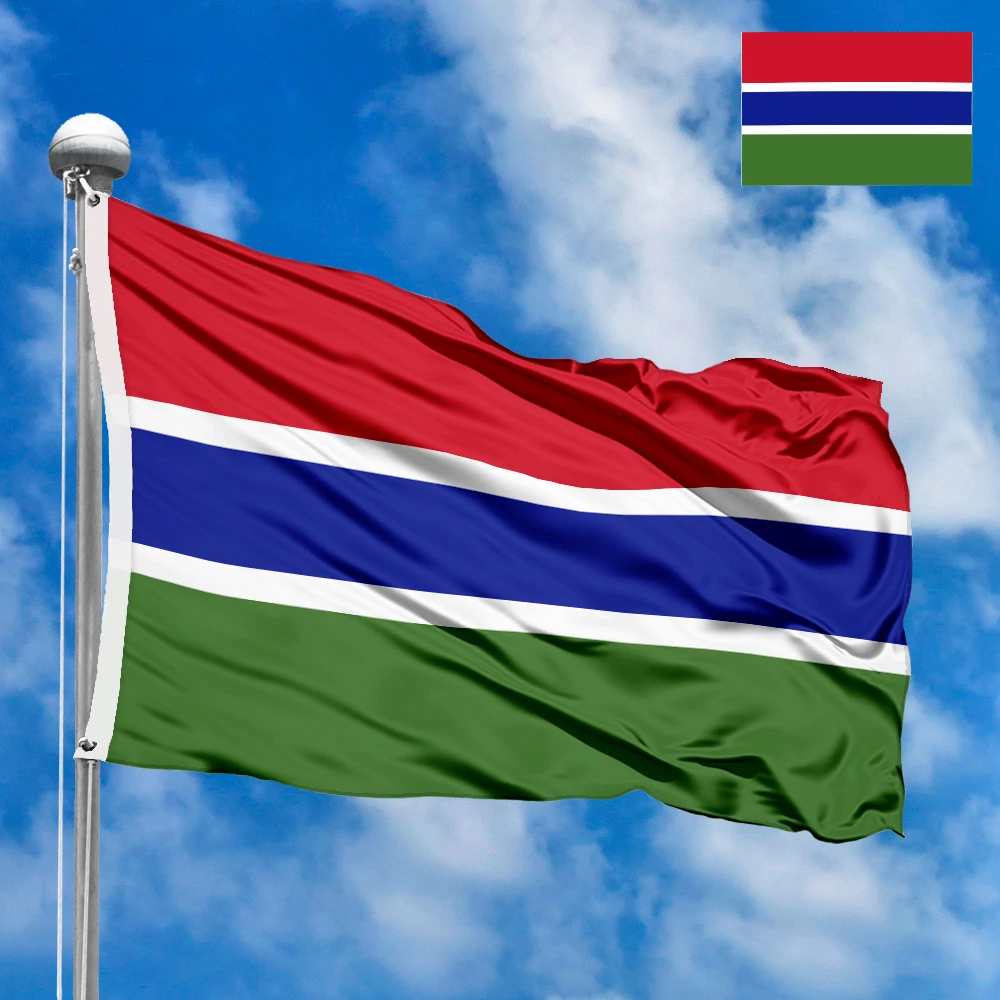
Flag of Gambia
- Flag Type: State
- Proportions (official): 2:3
- Official name: Republic of The Gambia
- Local name: The Gambia
- Sovereignty (year): YES (1965)
- Member of Organizations: UN, Commonwealth of Nations, African Union, Organization of Islamic Cooperation
- Country code, territory: GM, GMB, 270
- Capital: Banjul
- Large cities: Serekunda, Brikama, Bakau
- Population: ~2,700,000 (2024, UN)
- Religions: Islam ~96%, Christianity ~4%
- Area (km²): 11 300
- Highest point: Unnamed point (53 m)
- Lowest point: Atlantic Ocean (0 m)
- Currency: Gambian dalasi (GMD, D)
- Languages: English
- Dialing code: +220
- National domain: .gm
Flag Information
General information
Demography and Culture
Economy and communications

Description
The national flag of The Gambia is a compelling tapestry of color and symbolism, reflecting the nation's geographical essence, its aspirations for peace and prosperity, and the unwavering commitment of its people to unity. Adopted on February 18, 1965, the day The Gambia gained independence from British rule, it stands as a unique and visually striking emblem among the flags of West Africa. Unlike many of its regional counterparts that embrace the Pan-African colors, The Gambia’s flag offers a distinct narrative, deeply rooted in its specific environment and national ethos.
Design and Symbolism: A Dynamic Horizontal Composition
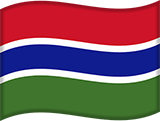
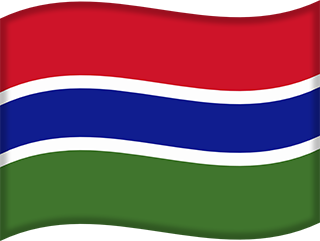
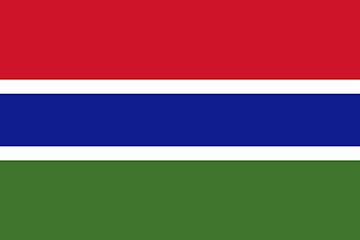
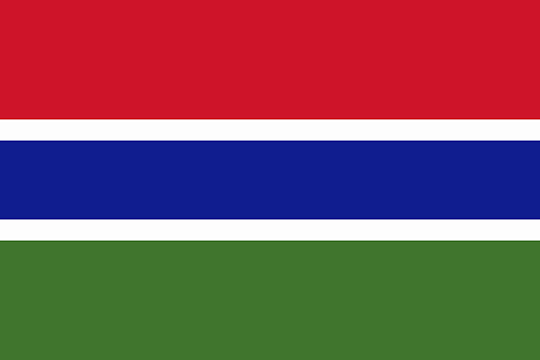
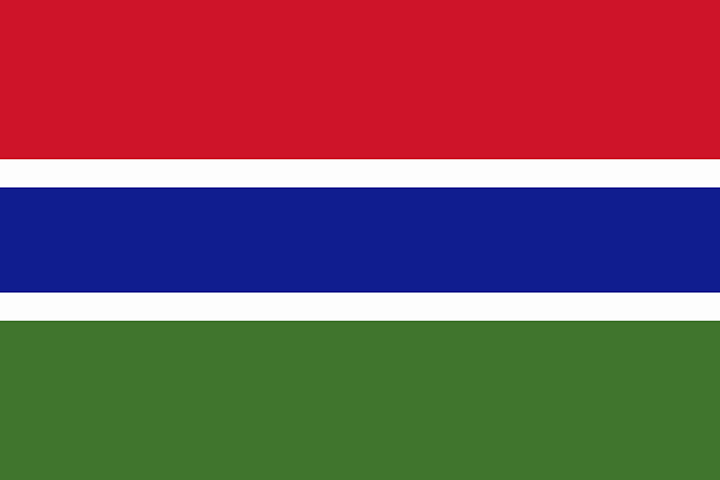
The flag of The Gambia features a horizontal design with five distinct elements, yet it is often described as comprising three main colored bands separated by thin white fimbriations. The arrangement, from top to bottom, is: red, thin white stripe, blue, thin white stripe, and green. Each color and the fimbriations carry significant meaning:
-
Red (Top Stripe): The uppermost red stripe symbolizes the sun and the savanna grasslands of The Gambia. It represents the warmth and vitality of the sun that nourishes the nation's crops and illuminates its landscapes. More profoundly, red also signifies the courage, determination, and sacrifices made by the Gambian people in their struggle for independence and in building their nation. It speaks to the energy and resilience that define the national character.
-
White (Upper Thin Stripe): The first thin white stripe, positioned directly below the red, represents peace and purity. It symbolizes the Gambian people's desire for harmony, both internally within the nation and externally in their relations with other countries. This color emphasizes transparency, honesty, and the tranquil environment that is essential for national development and progress. It acts as a clear separation, signifying a break from conflict and a move towards clear, peaceful intentions.
-
Blue (Middle Stripe): The central blue stripe is perhaps the most defining geographical symbol on the flag. It represents the Gambia River, which is the nation's namesake and its primary geographical feature. The Gambia River flows through the heart of the country, providing vital resources for agriculture, transportation, and sustenance. Blue also embodies hope and prosperity, reflecting the potential that the river offers for national development and the well-being of its citizens. It is a constant reminder of the lifeblood of the nation, sustaining its communities and economic activities.
-
White (Lower Thin Stripe): The second thin white stripe, mirroring the first, reiterates the themes of peace and purity. Its symmetrical placement emphasizes the enduring nature of these values and their pervasive presence throughout the national identity. It serves as a visual bridge, connecting the vital river to the fertile lands below, all under the umbrella of peace.
-
Green (Bottom Stripe): The lowermost green stripe symbolizes the agricultural wealth and natural resources of The Gambia. The country is largely agricultural, with fertile lands supporting crops like peanuts, rice, and millet. Green represents the lushness of the land, the forests, and the nation's reliance on and respect for its natural environment. It also signifies hope for the future and the verdant prosperity that can be achieved through diligent cultivation and sustainable practices.
Together, these colors and their arrangement paint a vivid picture of The Gambia: a nation blessed with natural resources, united by its river, striving for peace, and committed to a prosperous future, all under the vibrant African sun.
Dimensions and Proportions:
The official proportions of the Flag of The Gambia are a width-to-length ratio of 2:3. This standard ratio is commonly used for national flags globally, providing a balanced and aesthetically pleasing form. The three main colored stripes (red, blue, green) are not of equal height. Instead, they follow specific proportions relative to the overall height of the flag:
-
Red Stripe: Occupies 1/3 of the total flag height.
-
Upper White Fimbriation: Occupies 1/6 of the total flag height.
-
Blue Stripe: Occupies 1/3 of the total flag height.
-
Lower White Fimbriation: Occupies 1/6 of the total flag height.
-
Green Stripe: Occupies 1/3 of the total flag height.
This precise proportional division ensures that the blue stripe, representing the vital Gambia River, is prominently centered and flanked equally by the white stripes, reinforcing the idea of peace surrounding the nation's lifeline. The thin white fimbriations effectively separate the bold colors, enhancing their individual impact and clarity of symbolism. Such detailed specifications ensure uniformity and consistency in the flag's appearance across all official uses, from government buildings to international sporting events.
History and Evolution: From Colonial Emblem to National Identity
The history of The Gambia's flag is a concise yet powerful narrative, directly tied to its transition from a British colony to an independent nation.
-
Colonial Era (Pre-1965): Before gaining independence, The Gambia was a British Protectorate and Colony. During this period, the flag flown was the Blue Ensign of the United Kingdom, often defaced with a colonial badge. This badge typically featured a local scene, such as an elephant and palm tree, or simply the initials "G.C." (Gambia Colony). This colonial flag primarily represented British sovereignty rather than a distinct Gambian identity. There was no unique national emblem that symbolized the aspirations of the Gambian people for self-governance.
-
The Dawn of Independence (1965): As The Gambia prepared for independence, a national flag was needed to symbolize its newfound sovereignty. The country achieved full self-governance on February 18, 1965. A competition was held to design the new flag, reflecting the nation's unique characteristics and aspirations.
-
Designing the Flag: The winning design was submitted by Pa Louis Thomasi, an accountant by profession. His design was chosen because it effectively encapsulated the key elements of Gambian geography and national ideals. Notably, The Gambia opted not to use the Pan-African colors (red, gold/yellow, green), which were popularized by Ghana and adopted by many other newly independent African nations. This decision emphasized The Gambia's unique identity, primarily defined by its geographical feature, the Gambia River, and its commitment to peace and prosperity.
-
Adoption (February 18, 1965): The flag designed by Thomasi was officially adopted on February 18, 1965, the very day of independence. Its immediate adoption on this momentous occasion underscored the importance of establishing new national symbols that would rally the people and represent their independent status on the international stage.
-
Post-Independence Stability: Unlike some other nations that have undergone flag changes due to political upheavals, The Gambia's flag has remained unchanged since its adoption in 1965. This continuity reflects the enduring relevance of its symbolism and the stability of the national identity it represents, even through various political transitions and challenges. The flag has stood as a consistent beacon of Gambian nationhood for over half a century.
The flag's history, though brief in terms of changes, is deeply significant as it marks the pivotal moment of The Gambia's entry onto the world stage as a sovereign and self-determined nation, with a visual identity uniquely its own.
Regional Context and West African Identity:
The flag of The Gambia, while unique in its color palette compared to some of its West African neighbors, still holds a significant place within the regional and broader African identity, demonstrating both distinction and shared aspirations.
-
Distinctive Color Choice: One of the most striking aspects of The Gambia's flag in a regional context is its departure from the predominant use of Pan-African colors (red, gold/yellow, green). While many West African nations like Mali, Senegal, Guinea, and Benin adopted these colors to signify shared history, struggle against colonialism, and aspirations for African unity, The Gambia chose a different scheme. This choice highlights the nation's intent to forge a unique visual identity, largely centered around its defining geographical feature: the Gambia River. This distinction emphasizes a focus on its immediate environment and specific national characteristics rather than a broader ideological alignment through color.
-
Shared Aspirations (Peace and Prosperity): Despite the different color scheme, the underlying symbolic values on The Gambia's flag – particularly peace (white) and prosperity (green, blue) – resonate deeply with the aspirations of all West African nations. The region has historically faced challenges of conflict and underdevelopment, making the pursuit of peace and economic well-being a universal goal. In this regard, The Gambia's flag, through its symbolism, implicitly aligns with the broader regional objectives of stability and progress.
-
River as a Unifying Element: The prominence of the Gambia River (blue stripe) on the flag is a potent symbol of natural resources as a lifeline, a theme that echoes across many African nations where major rivers (like the Niger, Senegal) play crucial roles in economy and sustenance. This focus on the river provides a unique national identity while simultaneously reflecting a common reliance on natural endowments across the continent.
-
Post-Colonial Identity: Like its neighbors, The Gambia's flag emerged directly from the process of decolonization. Its creation in 1965 signifies a collective regional moment of newly asserted sovereignty and the establishment of distinct national symbols, moving away from colonial ensigns. It is part of the broader narrative of African nations defining themselves post-independence.
-
Subtle Influence: While not a direct stylistic influencer like Ghana's flag, The Gambia's flag subtly contributes to the diversity of African vexillology. It demonstrates that African identity is not monolithic but can be expressed through various symbolic means, each rooted in the unique context of a nation. Its clarity and directness of symbolism make it easily identifiable and memorable.
In essence, The Gambia's flag is a testament to its particular geographical and historical circumstances, choosing a path of distinctiveness in its visual representation while implicitly sharing fundamental aspirations for peace and development with its West African brethren. It stands as a unique and proud emblem within the vibrant tapestry of African flags.
Interesting Facts:
-
Unique Color Scheme in West Africa: The Gambia's flag is notable for not using the traditional Pan-African colors (red, gold/yellow, green) in its primary design, distinguishing it from many other West African flags.
-
Designed by a Gambian Citizen: The flag was designed by Pa Louis Thomasi, a Gambian accountant, through a national competition.
-
Adopted on Independence Day: It was officially adopted on February 18, 1965, the very day The Gambia gained independence from the United Kingdom.
-
River as Central Symbol: The blue stripe prominently represents the Gambia River, which is central to the country's geography, economy, and identity.
-
Symbolism of Peace: The two thin white stripes explicitly symbolize peace and purity, emphasizing these as core national values.
-
Stability of Design: The flag has remained unchanged since its adoption in 1965, reflecting the enduring relevance of its design and symbolism through various political periods.
-
Smallest Mainland African Nation: The Gambia is the smallest country on mainland Africa, almost entirely surrounded by Senegal, except for its Atlantic coastline. The flag's river symbol is particularly significant given this unique geography.
-
"Stripes of Harmony": The flag is sometimes colloquially referred to as the "Stripes of Harmony" due to its balanced composition and the emphasis on peace.
-
Agricultural Focus: The green stripe highlights The Gambia's strong reliance on agriculture and its rich natural resources.
-
Sun and Sacrifice: The red stripe represents both the African sun and the courage and sacrifices made by the Gambian people.
-
Clear Visual Narrative: The flag's design is praised for its clear and direct visual narrative, easily conveying its core meanings without complex imagery.
-
Distinct from Regional Flags: Its departure from common regional color schemes makes it easily recognizable and distinct when displayed alongside other West African flags.
Significance for the Inhabitants: A Banner of Identity, Unity, and Enduring Values
For the people of The Gambia, their national flag is far more than a mere piece of fabric; it is a profoundly meaningful and deeply cherished emblem that resonates with their collective identity, their rich history, and their aspirations for the future. It serves as a constant visual reminder of their hard-won independence, the vital role of their unique natural environment, and their unwavering collective commitment to peace, prosperity, and national unity. The flag is a living symbol that transcends diverse ethnic and linguistic groups, embodying the very essence of what it means to be Gambian and fostering a powerful sense of shared belonging.
The red stripe at the top evokes an immediate and powerful sense of national pride and the enduring spirit of resilience. It profoundly reminds Gambians of the brilliant and life-giving sun that shines perpetually over their fertile land, providing warmth and energy crucial for their agriculture and daily life. More deeply, it serves as a poignant reminder of the courage, determination, and the invaluable sacrifices made by their forefathers and mothers during the arduous struggle for freedom from colonial rule. This vibrant red color connects them to the fiery energy and unwavering spirit that built their nation, instilling a deep sense of gratitude for the past and inspiring continuous effort and vigilance for the future. It is a testament to the passionate commitment to their land and their sovereignty.
The two thin white stripes hold immense and critical significance as pervasive symbols of peace and purity. In a region that has historically faced and continues to navigate periods of conflict and instability, the strong emphasis on peace within The Gambia’s national symbol is paramount and deeply felt by its citizens. These stripes visually articulate the nation's unwavering desire for internal harmony among its various ethnic, religious, and social groups, as well as its resolute commitment to external tranquility and positive diplomatic relations with its neighbors and the wider global community. They represent a clear dedication to peaceful resolution of disputes, integrity in governance, and the aspiration for a just and transparent society. For the inhabitants, these pristine white lines serve as a constant aspiration for a serene, ethical, and principled existence, underpinning all aspects of national life and progress.
The central blue stripe is arguably the most cherished and defining element for every Gambian, representing the majestic and mighty Gambia River. This river is not just a geographical feature; it is literally the lifeblood of the nation, profoundly shaping its elongated geography and sustaining its people and economy. It symbolizes not only a physical waterway but also the hope, prosperity, and the vital resources it ceaselessly provides for agriculture, fishing, transportation, and communal sustenance. For Gambians, the blue stripe is a source of immense and deeply personal pride, connecting them directly to their land, their livelihoods, and their shared historical narrative that has unfolded along its banks. It represents the constant flow of life, opportunities, and the shared heritage that unites communities from the interior to the coast. It is a visual ode to their most precious natural asset.
Finally, the green stripe at the bottom embodies the rich agricultural wealth and the breathtaking natural beauty of their homeland. The Gambia is fundamentally an agrarian nation, and this color celebrates the fertility of its lands, the abundance of its crops (like groundnuts, rice, and millet), and its lush, vibrant natural environment, including its forests and diverse ecosystems. It speaks to the promise of sustainable development, food security, and the immense potential for a thriving and prosperous future built upon the diligent work of its farmers and the responsible stewardship of its invaluable natural resources. For Gambians, green is a powerful symbol of growth, renewal, and the inherent bounty of their country, inspiring a deep connection to their environment and a commitment to nurturing it for generations to come.
When the flag is proudly raised, whether during national celebrations, at educational institutions, during international sporting events, or at diplomatic forums, it consistently instills a profound collective sense of belonging, unity, and shared destiny among all Gambians. It serves as a powerful reminder of their unique identity, distinct from others, yet firmly rooted in universal values of peace, progress, and environmental respect. The flag of The Gambia is a beloved and revered emblem, a profound source of national pride, and a constant beacon of the nation's remarkable journey and its unwavering commitment to its core founding principles. It encapsulates the spirit of a resilient people and the promise of a harmonious future.
In the demonstration images, full-size flags are shown with proportions of 2:3, and hand-held flags with proportions of 1:2.
Donation
Together We create something more.
Thank you for being with us! We created this site for enthusiasts like you.
Your support helps us maintain the site, add new content and make it even better.
Let's build the most complete online community of flag lovers together!

Download
Completely free for commercial and non-commercial use (public domain).
You can freely use them in your news magazines, websites, software, mobile applications.
We appreciate a backlink to https://flagssite.com
Raster files - Flag of Gambia (PNG, JPG)
 Waving flag
- PNG format (transparent background), 72dpi, dimensions in Pixels (px), aspect ratio 3:4.
- 15х20 px
- 30х40 px
- 60х80 px
- 120x160 px
- 240x320 px
 Sizes:
"v15" - image size (by height); if necessary, replace with available: v15, v30, v60, v120, v240.
!!! For resizing, use the Latin (eng) keyboard layout.
<img src="https://flagssite.com/flags/v15/20408.png" alt="Flag of Gambia">
 Round flag
- PNG format (transparent background), 72dpi, dimensions in Pixels (px), aspect ratio 1:1.
 Sizes:
"d15" - image size (diameter); if necessary, replace with available: d15, d30, d60, d120, d240.
!!! For resizing, use the Latin (eng) keyboard layout.
<img src="https://flagssite.com/flags/d15/20408.png" alt="Flag of Gambia">
 Rectangular flag 2:3
- JPG format, 72dpi, dimensions in Pixels (px), aspect ratio 2:3.
 Sizes:





"h30" - image size (by height); if necessary, replace with available: h15, h30, h60, h120, h240, h360, h480.
!!! For resizing, use the Latin (eng) keyboard layout.
<img src="https://flagssite.com/flags/h30/20408.jpg" alt="Flag of Gambia">