
Flag of Athos, Athos, Aion Oros
- Flag Type: Regional
- Proportions (official): 2:3
- Official name: Autonomous Monastic State of the Holy Mountain
- Local name: Mount Athos
- Sovereignty (year): NO (Autonomous state within Greece)
- Capital: Karyes
- Population: ~1,800 (2024, estimate)
- Religions: Eastern Orthodox ~100%
- Area (km²): 335,6
- Highest point: Mount Athos (2,033 m)
- Lowest point: Aegean Sea (0 m)
- Dialing code: +30
- National domain: .gr
Flag Information
General information
Demography and Culture
Economy and communications



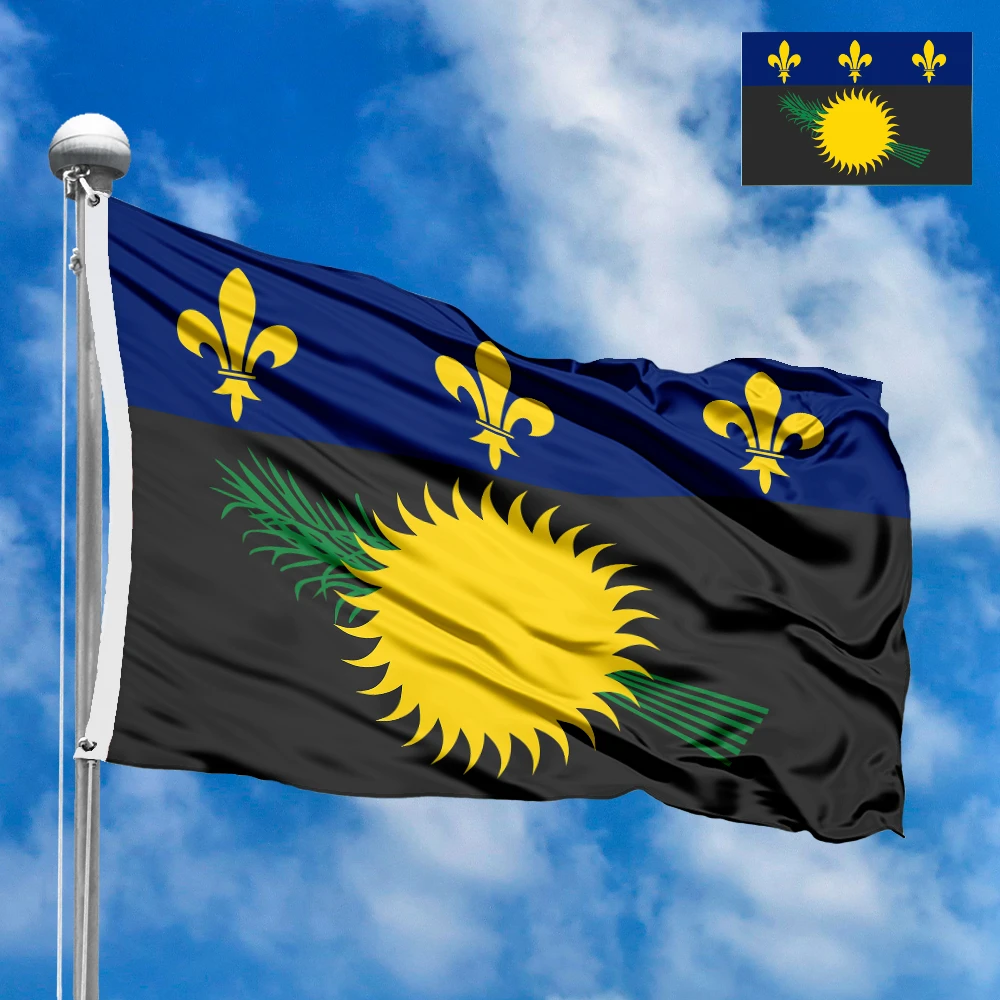

Description
The flag of Mount Athos, or the Holy Mountain, is not merely a symbol of a geographical area; it is a deeply revered banner of an autonomous monastic state under the sovereignty of the Hellenic Republic, which for over a thousand years has been a spiritual center of Eastern Orthodoxy. This flag embodies centuries of faith, asceticism, and unique self-governance, serving as a visible expression of the special status and spiritual mission of the Athonite monastic community.
Description and Elements of the Flag
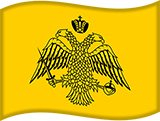
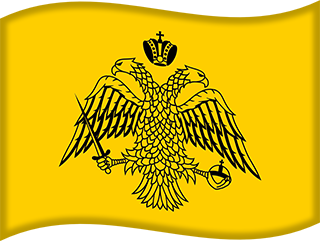
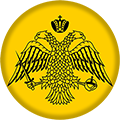
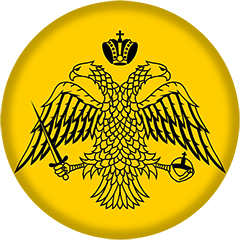
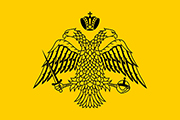
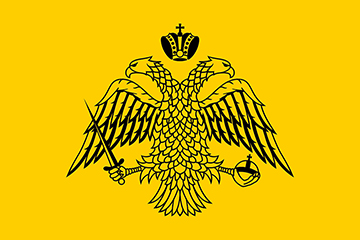
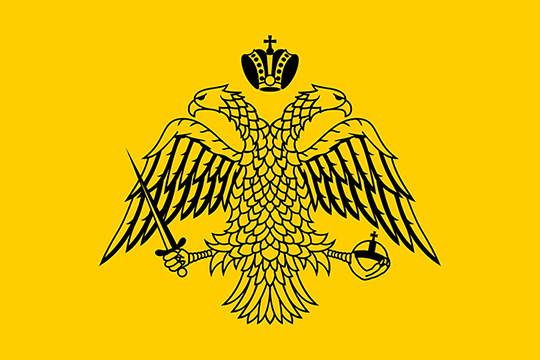
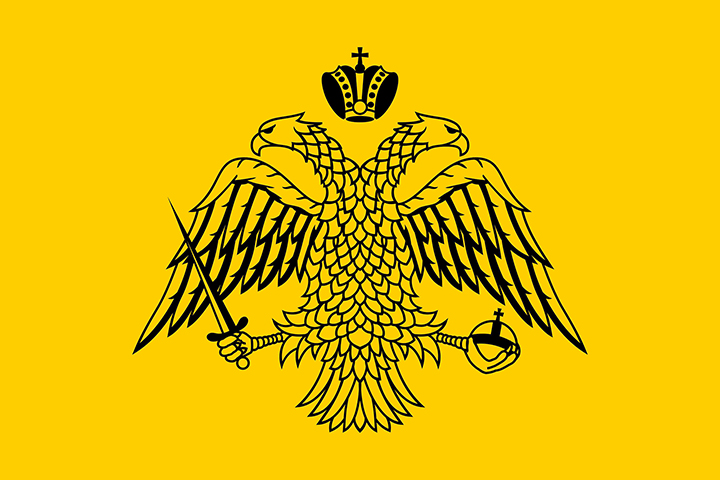
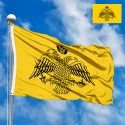
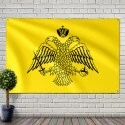
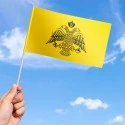
The main flag of Mount Athos, used for centuries, is deeply rooted in Byzantine tradition and symbolism. It features a yellow or golden field, upon which is depicted a double-headed eagle – the symbol of the Byzantine Empire. Between the eagle's heads, a crown is positioned. Sometimes, an orb symbolizing imperial power may be depicted below the eagle.
-
Yellow/Golden color: The traditional color of the Byzantine Empire, symbolizing majesty, royalty, sanctity, and divine light. It is a color associated with heavenly glory and spiritual purity.
-
Double-headed eagle: The principal heraldic symbol of the Byzantine Empire, inherited from the Roman Empire and symbolizing dual authority – secular and spiritual – or the embrace of East and West. On Mount Athos, it emphasizes the direct historical connection with Byzantium, from which the Holy Mountain received its autonomy and privileges. The eagle holds a scepter and an orb in its talons, symbols of power and governance.
-
Crown: Symbolizes royalty, divine patronage, and sovereignty. Its position between the eagle's heads emphasizes Mount Athos' direct link to the imperial authority of Byzantium, which granted the Holy Mountain its special status.
The flag's proportions generally conform to standard 2:3 ratios, although other variations may be found in monastic settings, especially on ancient banners. This flag is the official symbol of the Autonomous Monastic State of the Holy Mountain.
History of the Flag's Creation
The history of the flag of Mount Athos is inextricably intertwined with the history of the Byzantine Empire and the establishment of the monastic community on the Holy Mountain. Although the exact date of the flag's "creation" in the modern sense is unknown, its elements – the double-headed eagle and the crown on a golden background – date back to the Byzantine era, when Mount Athos received its first privileges and was placed under the direct patronage of the Byzantine emperors.
Initially, monastic communities did not have "flags" in the modern state sense. Rather, they had banners and standards with religious symbols, such as crosses, faces of saints, or icons, used in processions and liturgies. The double-headed eagle as a symbol of Byzantine patronage began to appear on Athonite documents, seals, and relics during the heyday of Byzantium. The crown, in turn, was an integral part of imperial symbolism, emphasizing the monarchical power and sovereignty that Byzantium granted to Mount Athos in the form of autonomy.
After the Fall of Constantinople in 1453 and the transition of Mount Athos under Ottoman rule, Byzantine symbolism, including the double-headed eagle and the crown, acquired special significance for Orthodox Christians, becoming a symbol of hope for revival and the preservation of spiritual identity. Mount Athos, possessing a special status of self-governance, continued to use these symbols, which now signified not only an imperial connection but also the unique autonomy and inviolability of the monastic republic.
During the Ottoman period and after Greece gained independence in the 19th century, the double-headed eagle on a golden background with a crown became the de facto recognized flag of Mount Athos. Its use was officially enshrined in the Constitutional Charter of the Holy Mountain of 1924, which legally formalized the autonomous status of Mount Athos within Greece. This document recognized Mount Athos' internal self-governance and its right to use its historical symbols.
Thus, the flag of Mount Athos was not "created" at a single moment but evolved from Byzantine imperial and ecclesiastical insignia, becoming a visible expression of the continuity of spiritual tradition and the unique political status of the Holy Mountain.
Country and Region
Mount Athos, or the Holy Mountain (Greek: Άγιον Όρος, Agion Oros), is a unique autonomous monastic state within the Hellenic Republic. Located on the Chalkidiki peninsula in the Central Macedonia region, Mount Athos is a UNESCO World Heritage site and holds a special status within the European Union, which recognizes its autonomy and special religious significance.
Administratively, Mount Athos is governed by the Holy Community (Ιερά Κοινότης), composed of representatives from all 20 ruling monasteries. The executive power is represented by the Holy Epistasia (Ιερά Επιστασία), consisting of four monks, including the Protos (Primate). The Greek state is represented by a governor who ensures compliance with Greek law and public order but does not interfere in the internal affairs of the monastic community.
Key aspects of Mount Athos' status:
-
Autonomy: Mount Athos enjoys broad autonomy, meaning it is governed by its own laws and rules, based on ancient Byzantine statutes and monastic traditions. External affairs, defense, and certain aspects of justice remain under the jurisdiction of Greece.
-
Monastic State: This is a unique form of governance where the entire territory is dedicated to monastic life. Access to Mount Athos is strictly regulated, and entry is permitted only to men.
-
Center of Orthodoxy: Mount Athos is one of the most important spiritual centers of Eastern Orthodoxy, where monastic traditions, Hesychasm, and Byzantine art have been preserved and developed for centuries.
The territory of Mount Athos covers the entire eastern peninsula of Chalkidiki, with the exception of a narrow strip of land connecting it to the mainland. It is a region entirely dedicated to prayer and asceticism, where worldly concerns are minimized.
Interesting Facts
-
Prohibition for Women ("Avaton"): Mount Athos observes an ancient rule known as "Avaton" (Άβατον), which prohibits women and female animals from entering the peninsula. This rule, enshrined in the Constitutional Charter, aims to ensure the complete silence and chastity of monastic life.
-
20 Ruling Monasteries: Mount Athos is home to 20 great monasteries, which are self-governing and hold stavropegial status (meaning they are directly subordinate to the Ecumenical Patriarch of Constantinople). In addition, there are also sketes, cells, and kalives.
-
Unique Timekeeping: Some monasteries on Mount Athos still use Byzantine time, where the new day begins at sunset, and the Julian calendar.
-
Cultural Treasure: Mount Athos is a repository of priceless Byzantine manuscripts, icons, frescoes, and ecclesiastical relics, making it one of the greatest treasuries of global cultural and religious heritage.
-
Observer at the UN: Although Mount Athos is not a member of the UN, the Holy Community, as a unique autonomous entity, has a special status and periodically interacts with international organizations on matters of cultural heritage and religious freedom.
-
"Garden of the Mother of God": Mount Athos is traditionally venerated as the earthly portion of the Most Holy Theotokos (Mother of God), where, according to tradition, she stepped after the Resurrection of Christ, and where, by her will, the presence of women is not permitted.
Adoption and Significance for Inhabitants (Monks)
The adoption of the flag of Mount Athos, like its formation, was an organic process, closely linked to the history of Byzantium and the subsequent development of the Holy Mountain's autonomous status. For the monks and inhabitants of Mount Athos, the flag holds profound significance, extending beyond a simple national or state symbol.
For the inhabitants of Mount Athos, the flag signifies:
-
Spiritual Identity: It is a symbol of their belonging to an ancient monastic tradition and Eastern Orthodoxy. The golden color, the double-headed eagle, and the crown recall the eternity of spiritual values and sacrificial service.
-
Autonomy and Independence: The flag emphasizes the unique autonomous status of Mount Athos, allowing it to preserve its traditions and way of life without direct interference from secular authorities. It is a symbol of their freedom in serving God.
-
Connection to Byzantium: For the monks, the flag is a living link to the Byzantine Empire, from which Mount Athos received its privileges and which was the cradle of Orthodoxy. It recalls the Byzantine heritage and its preservation on the Holy Mountain.
-
Protection and Patronage: The double-headed eagle, historically symbolizing imperial protection, is now perceived as a symbol of heavenly patronage and constant divine protection that guards Mount Athos from worldly upheavals. The crown further reinforces this concept, indicating royal patronage.
-
Unity of the Monastic Community: Despite the differences between the monasteries, the flag serves as a powerful symbol of the unity of all 20 ruling monasteries and the monastic community as a whole, united under the banner of faith and asceticism.
-
Mission and Testimony: The flag of Mount Athos, flying above the monasteries and proskynitaria, is a visible testimony to the world of the existence of a unique place dedicated to prayer, Hesychasm, and spiritual perfection.
Thus, the flag of Mount Athos is not merely a heraldic emblem but a deeply symbolic image that reflects the millennium-long history, unique autonomous status, spiritual mission, and unwavering faith of the monastic community, which continues its prayerful and ascetic life in the "Garden of the Mother of God."
In the demonstration images, full-size flags are shown with proportions of 2:3, and hand-held flags with proportions of 1:2.
Donation
Together We create something more.
Thank you for being with us! We created this site for enthusiasts like you.
Your support helps us maintain the site, add new content and make it even better.
Let's build the most complete online community of flag lovers together!

Download
Completely free for commercial and non-commercial use (public domain).
You can freely use them in your news magazines, websites, software, mobile applications.
We appreciate a backlink to https://flagssite.com
Raster files - Flag of Athos, Athos, Aion Oros (PNG, JPG)
 Waving flag
- PNG format (transparent background), 72dpi, dimensions in Pixels (px), aspect ratio 3:4.
- 15х20 px
- 30х40 px
- 60х80 px
- 120x160 px
- 240x320 px
 Sizes:
"v15" - image size (by height); if necessary, replace with available: v15, v30, v60, v120, v240.
!!! For resizing, use the Latin (eng) keyboard layout.
<img src="https://flagssite.com/flags/v15/20260.png" alt="Flag of Athos, Athos, Aion Oros">
 Round flag
- PNG format (transparent background), 72dpi, dimensions in Pixels (px), aspect ratio 1:1.
 Sizes:
"d15" - image size (diameter); if necessary, replace with available: d15, d30, d60, d120, d240.
!!! For resizing, use the Latin (eng) keyboard layout.
<img src="https://flagssite.com/flags/d15/20260.png" alt="Flag of Athos, Athos, Aion Oros">
 Rectangular flag 2:3
- JPG format, 72dpi, dimensions in Pixels (px), aspect ratio 2:3.
 Sizes:
"h30" - image size (by height); if necessary, replace with available: h15, h30, h60, h120, h240, h360, h480.
!!! For resizing, use the Latin (eng) keyboard layout.
<img src="https://flagssite.com/flags/h30/20260.jpg" alt="Flag of Athos, Athos, Aion Oros">